

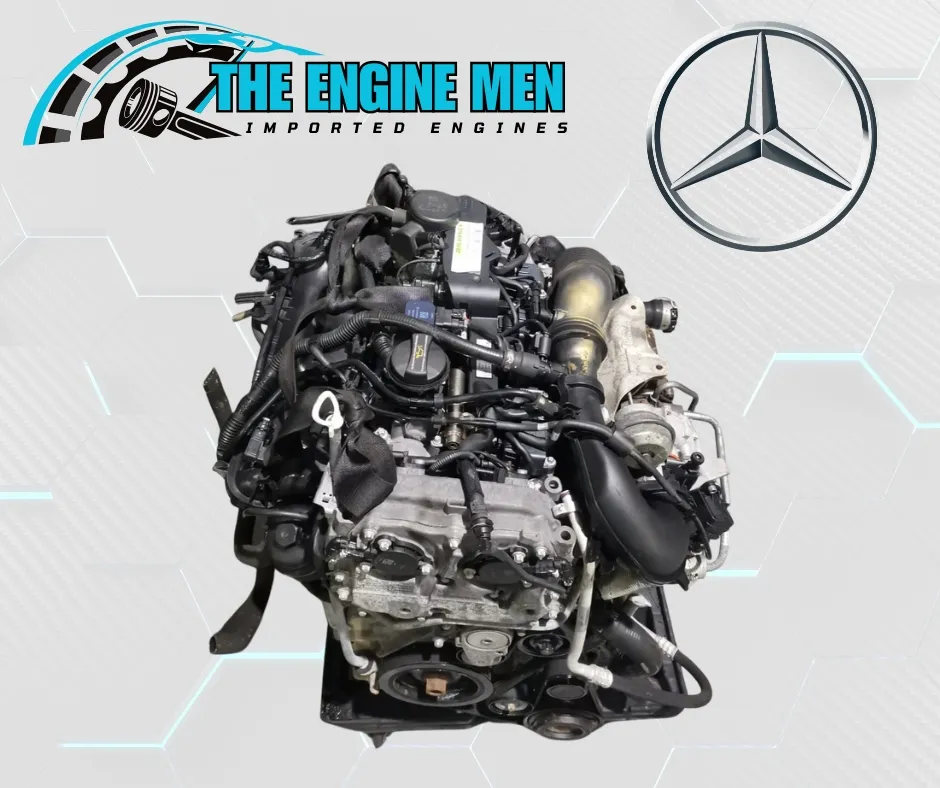

Mercedes 1.6t 270 9 engine
R72,000.00
Mercedes 1.6t 270 9 engine is identified in this product by its engine family and stated vehicle application. The SKU “270 9” appears to refer to the M270.910 family designation. This is a 1.6-litre turbocharged direct-injection petrol four, not an engine code written in the usual complete Mercedes format. M270 engines were installed transversely in compact front-wheel-drive platforms, with output and ancillaries varying by suffix and model.
Mercedes 1.6t 270 9 engine engine specification and code
- Engine code: 270 9
- Fuel: Petrol
- Configuration: inline-four
- Induction: Petrol, with aspiration and fuel system determined by the full engine code
- Listed vehicle: Mercedes 1.6t 270 9 engine
The badge, capacity and engine-family name provide a useful first check, but replacement fitment depends on the complete stamped code and vehicle data. Read the engine number and match it to the VIN, production date, gearbox and drivetrain. Where a catalogue entry uses a short code or groups models, ask the supplier to confirm the exact available unit. This avoids choosing an engine based only on a shared displacement or model badge.
Application and compatibility for 270 9
Check the recipient model, VIN, build date, gearbox and full engine number. The M270 and longitudinal M274 family may share design features but are not interchangeable as assemblies. Compare mounts, sump, turbo, fuel pump, injectors, wiring, sensors and exhaust position. Clarify whether “270 9” means M270.910 and request a photo of the engine stamp.
Compare the old and replacement assemblies before installation. Check sump shape, engine mounts, gearbox interface, starter position, intake and exhaust routing, coolant outlets, accessory brackets, sensors and electrical connectors. Establish whether the product is supplied as a long block or a dressed engine. Confirm which fuel-system components, turbo or supercharger, manifolds, wiring and accessories are included and which must transfer. Inspect reused parts before fitting, especially anything related to the original failure.
Parts to verify on the 270 9 engine
Ask what parts are supplied with the engine: turbo, intake and exhaust manifolds, high-pressure pump, injectors, loom and accessory brackets can differ by application. The compact transverse layout means clearance and mount position are decisive. Have the workshop confirm the correct ECU and immobilizer pairing before transferring components from the original engine.
Installation and commissioning
Check turbo oil and coolant lines, direct-injection fuel components, cooling system, intake tract and crankcase ventilation. Use the vehicle’s exact service data for oil and filter requirements. After installation, scan for boost, fuel-pressure, cam timing and sensor faults, then confirm stable idle and operating temperature. Do not rely on the short inventory SKU to make final fitment decisions.
Use the manufacturer’s service information for the recipient vehicle when selecting fluids and performing the first start. Resolve the original fault, refill and prime systems as required, then check oil pressure, coolant circulation, fuel connections and wiring grounds. Scan the engine and transmission electronics for stored faults. Verify stable idle, normal temperature, charging and leak-free operation before a road test. Record the complete engine code and any transferred components with the service paperwork. Document the M270.910 suffix and transverse compact-car packaging as part of the fitment notes, since this detail helps distinguish the installed version from related engines in the same product family.
Order the correct Mercedes 1.6t 270 9 engine
Send the VIN, vehicle year, gearbox, drivetrain and a clear photograph of the engine stamp when requesting fitment confirmation. Ask which full engine code is being supplied and whether the turbo, supercharger, injectors, manifolds, sensors and accessories are included. Resolve any mismatch between the product name, stock code and engine stamping before purchase. Browse the engine and gearbox catalogue and compare the listed unit with your original.
For further technical context, consult M270.910 engine identification and technical overview. This reference can help explain the M270.910 suffix and transverse compact-car packaging, while final compatibility should be confirmed against the recipient VIN and engine number. Choosing a correctly identified Mercedes 1.6t 270 9 engine gives the installer a clear basis for component matching and commissioning.
Can you deliver the Mercedes 1.6t 270 9 engine nationwide?
Yes. The Engine Men ships the Mercedes 1.6t 270 9 engine nationwide across South Africa. Provide your delivery town or suburb when requesting a quote so the team can confirm the shipping cost and arrangements for your address.
Will the Mercedes 1.6t 270 9 engine fit in my vehicle?
If your vehicle is one of the applications named in the product title and its original engine matches 270 9, this is the listed replacement specification. The product is identified for Mercedes 1.6t 270 9 engine. Before ordering, also match the vehicle year and generation, transmission, drivetrain, market specification, ECU, sensors and ancillary components. A shared engine code alone does not always guarantee a direct fit. Send The Engine Men your VIN and a photo of the original engine code for a fitment check.
Can you supply and fit the Mercedes 1.6t 270 9 engine into my car?
The Engine Men offers an engine supply and fit service. Contact the team with your vehicle details to confirm that the Mercedes 1.6t 270 9 engine is suitable, check installation availability and request a quote. Engines supplied and fitted by The Engine Men are subject to a 6-month / 20,000-kilometre guarantee under the applicable terms. A service by The Engine Men three months after the invoice date is required for the remaining three months of the guarantee to apply.
Is the Mercedes 1.6t 270 9 engine brand new or second hand?
The Mercedes 1.6t 270 9 engine is a used engine, not a brand-new unit. The Engine Men sources used engines from the UK. Unless specifically stated otherwise in writing, engines are represented as having mileage below 100,000 kilometres. Mileage information is based on details available to The Engine Men and/or supplied with the engine.
Can you export the Mercedes 1.6t 270 9 engine to Namibia, Botswana or Zimbabwe?
Yes. The Engine Men can export the Mercedes 1.6t 270 9 engine to Namibia, Botswana and Zimbabwe. Contact the team with the destination town and product details to confirm the export quote, transport arrangements, required documentation and expected delivery timeframe.
How long does delivery of the Mercedes 1.6t 270 9 engine take?
The Engine Men ships the Mercedes 1.6t 270 9 engine nationwide across South Africa. Delivery timing depends on stock availability, destination and transport arrangements. Contact the team with your location and product details for a current dispatch and delivery estimate before ordering.